PCOS Irregular Periods: Ayurvedic and Modern Treatments
What the evidence really says about ayurvedic remedies and modern medicines for PCOS periods, and how to use both sensibly.
 Dr. Geeta S. K.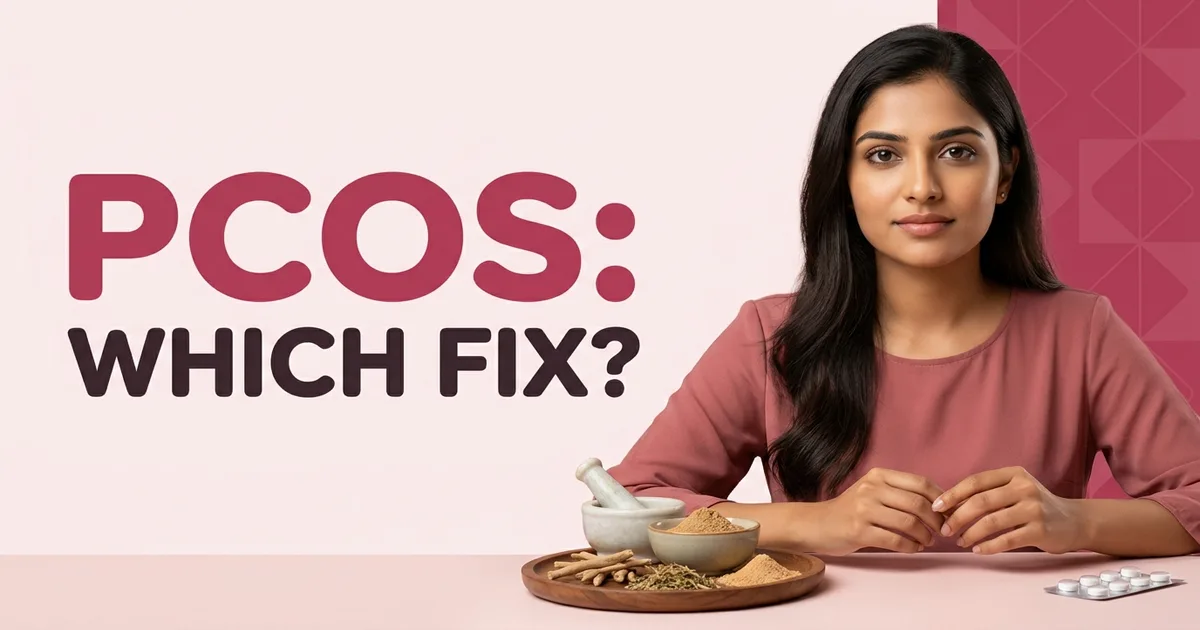
The short answer: Modern medicine has proven treatments for PCOS cycles. The combined pill is the recommended first medicine for irregular periods, letrozole is first choice when you are trying to conceive, and metformin helps the metabolic side. Ayurvedic and herbal remedies do not have that evidence. Careful reviews found no high-quality proof that herbal medicines regulate cycles in PCOS, and thin safety data. I am not against our traditional remedies. I am against you losing years to them.
What you will learn
- What each modern medicine does, and what it does not do
- An honest evidence rating for the popular ayurvedic remedies
- Why "natural" and "safe" are not the same word
- Which treatment fits which goal: regular cycles, skin, or pregnancy
- How to combine both without wasting time or money
What are the modern treatment options?
Treatment in PCOS is chosen by your goal, not by the diagnosis alone. Two women with identical reports get different prescriptions if one wants regular cycles and the other wants a baby this year.
| Your goal | First-line treatment | What it does |
|---|---|---|
| Regular cycles, not trying to conceive | Combined oral contraceptive pill | Gives a predictable bleed and protects the lining of the uterus |
| Acne and unwanted hair | Combined pill, with other treatments added if needed | Lowers the effect of male-type hormones over months |
| Trying to conceive | Letrozole | Triggers ovulation. Clomiphene, alone or with metformin, is second choice |
| Blood sugar and metabolic health | Metformin | Improves how the body handles insulin. The guideline prefers it over inositol for unwanted hair and waist fat |
| All of the above, underneath | Food, movement, weight where relevant | Works on the cause rather than the symptom |
Two honest points about the pill, because women ask me both every week. It manages rather than cures, so cycles usually return to their old pattern after stopping. And it is not merely cosmetic. Long stretches without a bleed leave the lining of the uterus under oestrogen with no progesterone to shed it, and women with PCOS carry roughly 2 to 6 times the endometrial cancer risk of women without it, although for a young woman the everyday risk stays small. If you cannot take the pill, cyclical progesterone tablets or a hormone-releasing device do the same protective job.
Does Ayurveda work for PCOS irregular periods?
I want to answer this the way I would answer my own sister.
The careful reviews are consistent, and they are not encouraging. There is no high-quality evidence that nutritional supplements or herbal medicines improve PCOS, and evidence on their safety is lacking. Looking specifically at menstrual regularity, women taking herbal medicine did no better than the comparison groups. The same review looked at green tea, cinnamon, spearmint and black cohosh across PCOS outcomes and found limited high-quality trial evidence and inadequate safety data; where cycle regularity was actually measured, as with green tea and cinnamon, no benefit was found. A Cochrane review of Chinese herbal medicine in PCOS-related subfertility found insufficient evidence to recommend it, with no clear benefit over clomiphene for pregnancy rates on very low certainty evidence.
That does not mean every plant is useless. It means we do not have the proof that would let me, as a doctor, tell you to rely on them.
| Remedy | What the research actually shows | Evidence |
|---|---|---|
| Spearmint tea | 2 cups daily lowered free testosterone over 30 days. Women felt their hair growth improved, but the measured change was not significant | Weak to moderate, for hormones only |
| Cinnamon (dalchini) | Reviewed in PCOS. Where cycle regularity was measured, no benefit was found | Weak |
| Green tea | Assessed for absent periods in PCOS. No difference from the comparison group | Weak |
| Black cohosh | Studied alongside fertility medicines for pregnancy rates, not for cycle regularity on its own | Weak, and off-target |
| Fenugreek (methi) | Not covered in the main PCOS review, so there is nothing solid either way for cycles | Not assessed |
| Polyherbal ayurvedic formulations | Traditional use is long, but controlled trials are few and small, and no high-quality evidence supports them | Weak |
Is "natural" the same as "safe"?
No, and this is the part I most want you to take away.
Herbal products are not tested batch by batch the way prescription medicines are, so what is on the label may not match what is in the bottle. Contamination is a documented concern too. A study that bought 230 ayurvedic products sold online, made in both India and the United States, found detectable lead, mercury or arsenic in about one in five of them, rising to 40% among rasa shastra preparations, where metals and minerals are deliberately combined with herbs.
The reviews say the rest plainly: safety evidence is lacking. That is not the same as saying something is proven safe.
There is a second cost that no label mentions. Every month spent on a herbal course is a month your thyroid was not tested, your prolactin was not checked, and your lining was not protected. In my clinic, the real damage from herbal remedies is almost never the herb. It is the delay.
So how do I combine both sensibly?
This is what I actually suggest, and it lets you keep what you love without losing time.
- Get the diagnosis right first. Thyroid and prolactin blood tests, then hormone tests if the pattern fits PCOS. No treatment of any kind before this.
- Put lifestyle underneath everything. This is where our tradition genuinely shines. The Karnataka plate of millets, dals, palya and buttermilk is close to what the evidence recommends, and food is the one lever that works on the cause. My guide to restoring cycles naturally with PCOS covers it fully.
- Use modern medicine for the specific job it does. Cycles, ovulation, or metabolic health, chosen by your goal from the table above.
- Keep the herbs you enjoy, as habits. Methi in the cooking, spearmint tea in the evening, dalchini in your milk. Pleasant, low-risk, unproven, and no longer carrying the burden of being your treatment.
- Tell your doctor everything you take. Including the ayurvedic ones. Some interact with prescription medicines, and I cannot warn you about what I do not know.
One more current note. In May 2026, after more than a decade of global consultation, PCOS was renamed polyendocrine metabolic ovarian syndrome, or PMOS, to reflect that it is a hormonal and metabolic condition rather than a problem of ovarian cysts. The rename does not change the criteria used to diagnose it, or the treatments above.
Stop the herbal course and see a doctor if
- You have taken it for 3 months with no change in your cycles
- You have had no period for 3 months, or any gap over 90 days
- You are trying for a baby and losing months to remedies instead of treatment
- You have never had a thyroid or prolactin test
- You develop nausea, yellowing of the eyes, rashes, or abdominal pain on a supplement
- You are taking a herbal product alongside prescription medicine without telling anyone
Your questions, answered
Can Ayurveda cure PCOS?
There is no good evidence that it can. Reviews of herbal and supplement treatments in PCOS found no high-quality evidence of benefit and inadequate safety data. Traditional remedies can sit alongside proper treatment as habits, but relying on them as a cure means going without something that works.
Is the contraceptive pill harmful long term?
For most healthy women it is a well-studied medicine, and it is the recommended first choice for irregular cycles in PCOS. It has real risks in specific situations, such as smoking, migraine with aura, or a clotting history, which is exactly why it needs a doctor's assessment rather than a friend's recommendation.
Which is better for pregnancy, letrozole or ayurvedic treatment?
Letrozole, without hesitation. It is the first-line medicine for triggering ovulation in PCOS when there is no other fertility factor. The herbal comparison here is not close: a Cochrane review found no clear benefit of Chinese herbal medicine over clomiphene for pregnancy rates, on very low certainty evidence, and insufficient evidence to recommend the herbs at all.
My periods came back on an ayurvedic course. Was it the medicine?
Possibly, but there are two other explanations that are more likely. Most of these courses come with diet and lifestyle instructions, and those genuinely work. And PCOS cycles fluctuate on their own, so an isolated period after a long gap is common. If your cycles hold steady for 6 months, that is worth something either way.
Do I have to choose one or the other?
No. Keep the food and habits from tradition, use modern medicine for the job it is proven to do, and get your tests either way. That combination is what I recommend most often.
Is metformin or inositol better?
The guideline prefers metformin over inositol for unwanted hair and waist fat, and says inositol offers limited clinical benefit with no specific type or dose that can be recommended. Metformin is used mainly for the metabolic side rather than as a cycle treatment on its own.
Bring me what you are taking, all of it
If you are on an ayurvedic course, or you have been offered the pill and you are unsure, bring the bottles and your reports. In a 30-minute video call we will decide what to keep, what to stop, and what is actually missing.
For the clinical side of irregular periods, including which tests come in which order, read my guide to menstrual disorders and when they need treatment. For the plate itself, my PCOS diet guide for Indian foods has the full chart and meal plan.
Sources for this article (10)
- International Evidence-based Guideline for the Assessment and Management of PCOS, JCEM, 2023 (accessed July 2026)
- ASRM summary of the 2023 PCOS guideline recommendations (accessed July 2026)
- Arentz et al., Nutritional supplements and herbal medicines for women with PCOS: systematic review and meta-analysis, 2017 (accessed July 2026)
- Grant, Spearmint herbal tea and androgen levels in PCOS, Phytotherapy Research, 2010 (accessed July 2026)
- Zhou et al., Chinese herbal medicine for subfertility associated with PCOS, Cochrane Database of Systematic Reviews, 2021 (accessed July 2026)
- Saper et al., Lead, mercury and arsenic in US and Indian manufactured ayurvedic medicines sold via the internet, JAMA, 2008 (accessed July 2026)
- Marsh et al., Effect of a low glycemic index diet in PCOS, American Journal of Clinical Nutrition, 2010 (accessed July 2026)
- Endometrial cancer risk in women with PCOS and how it is reduced, 2023 (accessed July 2026)
- WHO fact sheet: Polycystic ovary syndrome (accessed July 2026)
- Teede et al., Polyendocrine metabolic ovarian syndrome, the new name for PCOS, The Lancet, 2026 (accessed July 2026)
This article is for your information and learning. It is not a substitute for a consultation. For advice about your own health, talk to me or your own doctor.
About Dr. Geeta S. K.
Dr. Geeta S K, MBBS, DGO, FRM, DRM (Germany), is a gynecologist and fertility specialist. She provides clear, compassionate guidance on PCOS, pregnancy, fertility and women's health.