PCOS Weight Loss: Exercise and Habits That Actually Help
Struggling with PCOS weight gain? Discover proven Indian diet plans, effective exercises, and lifestyle changes to manage PCOS weight naturally.
 Dr. Geeta S. K.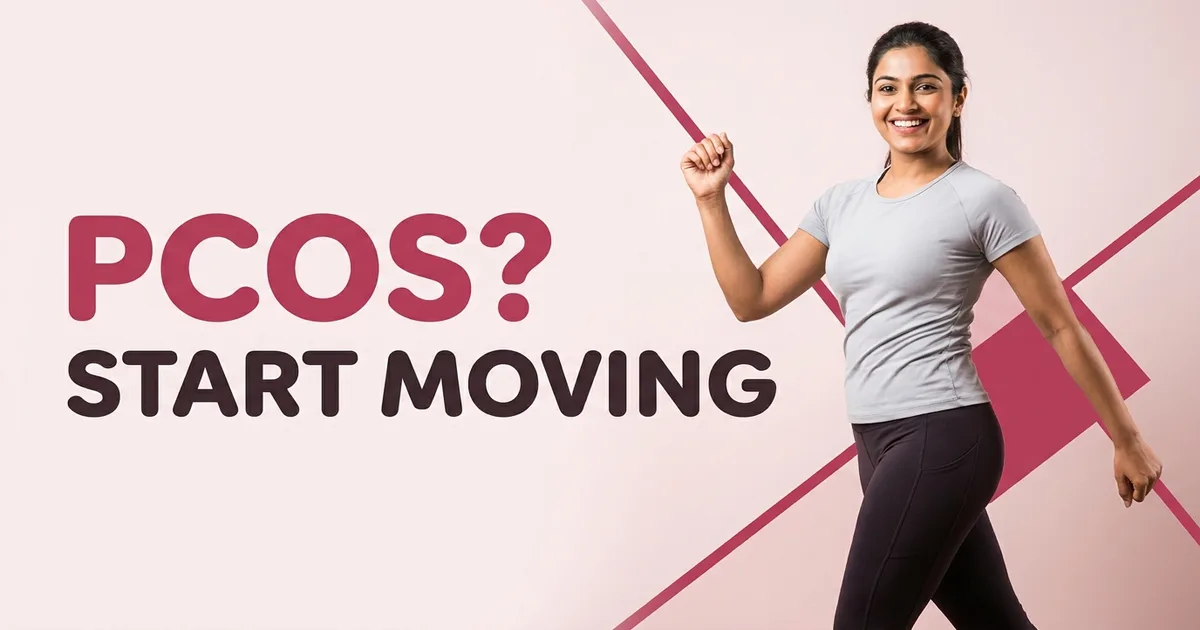
The short answer: Managing PCOS well is more than dieting. It rests on five levers working together: steady food, regular movement, good sleep, lower stress, and the right medical care. For movement, aim for 150 to 300 minutes of moderate activity a week plus strength exercise on 2 days. Walking lowers the high insulin that drives PCOS, and strength work builds muscle that helps use up sugar. Add 7 to 8 hours of sleep, because a third of women with PCOS have hidden sleep problems that worsen insulin. This guide gives you a simple weekly movement plan, the sleep and stress fixes that matter, and exactly when to see a doctor.
What you will learn
- The five levers that actually move PCOS, in priority order
- A weekly movement plan: how many minutes and which type
- Why strength training matters as much as walking
- The sleep and stress fixes most women skip
- Which tests to ask for and when to see your doctor
What actually manages PCOS long term?
Not one perfect diet, and not one magic pill. PCOS (polycystic ovary syndrome, a hormone condition) responds best when several everyday levers pull together. Most women focus only on food and feel stuck. The women who truly get their cycles, skin, and energy back are the ones who add movement, sleep, and stress care on top.
Here is why these levers work. In most women, PCOS is driven by insulin resistance, where the body's cells stop responding to insulin and it piles up in the blood. That extra insulin pushes the ovaries to make more male-type hormones, which disturbs ovulation. For most women, the food, movement, sleep, and stress levers below work by calming that insulin, while medical care checks and treats what lifestyle cannot. Understand the engine in my guide to PCOS and insulin resistance.
Food is lever one, so let me settle it quickly and move on. Eat a protein-rich, low-GI Indian plate: dal, curd, eggs or paneer at every meal, more millets like ragi and jowar, half portions of rice, and half the plate as vegetables. The full food chart and 7-day plan are in my PCOS diet guide, and the weight-loss version is in my PCOS weight-loss diet plan. This guide is about everything else.
How much exercise do I need for PCOS?
Aim for 150 to 300 minutes of moderate movement a week, plus strength exercise on 2 days. That is the target in the 2023 international PCOS guideline, and it matters because the two kinds of exercise help in different ways: walking lowers insulin directly, and strength work builds the muscle that uses up sugar.
Moderate means you can talk but not sing: a brisk walk, cycling, dancing, or swimming. Spread across the week, 150 minutes is just over 20 minutes a day, or a 30 to 40 minute walk five days a week. If weight loss is a goal, push toward 250 minutes a week. Reviews of exercise trials in PCOS show aerobic activity meaningfully lowers fasting insulin, and strength training builds the lean muscle that soaks up sugar.
Do not overdo it. Very long, very intense workouts every day can raise stress hormones and backfire in PCOS. Steady and regular beats punishing. A walk after dinner is one of the simplest blood-sugar tools you have.
Which type of exercise helps what?
| Exercise | How often | What it helps |
|---|---|---|
| Brisk walking or cycling | Most days, 30 to 40 min | Lowers fasting insulin, burns calories, lifts mood |
| Strength or resistance training | 2 days a week | Builds muscle that soaks up sugar, raises resting metabolism |
| Yoga or stretching | 1 to 2 days | Lowers stress and cortisol, aids recovery and sleep |
| Everyday activity (stairs, chores) | Daily | Adds up, keeps blood sugar steadier between workouts |
Start where you are. If you do nothing today, begin with a 10-minute walk after lunch and grow from there. Consistency over six months beats a heroic week you cannot repeat.
Why does sleep matter so much in PCOS?
Because poor sleep quietly raises insulin, and PCOS often comes with hidden sleep problems. Up to 35 percent of women with PCOS have obstructive sleep apnoea, where breathing pauses during sleep, and it makes insulin resistance worse. Even without apnoea, short or broken sleep pushes hunger hormones up and willpower down the next day.
Aim for 7 to 8 hours on a fixed schedule. A steady sleep and wake time is a hormone treatment you get for free. If you snore heavily, wake gasping, or feel exhausted despite a full night in bed, tell your doctor, because sleep apnoea is treatable and worth catching.
- Keep the same sleep and wake time, even on weekends.
- Put the phone away 30 minutes before bed; the screen light delays sleep.
- Avoid heavy meals, strong tea, or coffee late in the evening.
- A dark, cool, quiet room helps more than any supplement.
How does stress make PCOS worse?
Constant stress keeps cortisol high, and cortisol raises blood sugar and insulin, the exact things PCOS already struggles with. Stress also drives comfort eating and breaks sleep, so it hits three levers at once.
You cannot remove stress from life, but you can lower its grip. Ten minutes of slow breathing, a daily walk, prayer, journaling, or time with people who lift you all genuinely lower stress hormones. This is not soft advice; it is metabolic care. For a fuller toolkit, see my stress management guide for Indian women.
When should I see a doctor, and what tests do I need?
See a doctor at diagnosis, then for review if the everyday levers are not moving your cycles or symptoms after about 3 months. PCOS needs monitoring over time, not just a one-time visit, because it raises long-term risks like diabetes that are easy to catch early.
| Test | Why it matters |
|---|---|
| Glucose tests (OGTT preferred, or fasting glucose and HbA1c) | Catch pre-diabetes early; the 75g glucose tolerance test (OGTT) is the most accurate, whatever your weight |
| Lipid profile (cholesterol) | PCOS can raise heart-disease risk over time |
| Thyroid (TSH) | Thyroid problems mimic and worsen PCOS symptoms |
| Testosterone and related hormones | Confirms the androgen picture, guides treatment |
| Prolactin and 17-OHP (at diagnosis) | Rule out other hormone causes before PCOS is confirmed |
| Blood pressure and weight or waist | Tracks the metabolic risks that grow silently |
On medicines: metformin is the standard, well-tested option for the insulin side of PCOS. Inositol is a supplement with limited, low-certainty evidence for some insulin markers and an unclear effect on cycles, and the 2023 guideline does not endorse it as a fertility treatment, so treat it as a possible helper you discuss with your doctor. Newer GLP-1 weight-loss injections are now in international guidance for obesity in PCOS but are prescription-only and need supervision. The weight-focused detail on all three is in my PCOS weight-loss diet plan.
See a doctor without waiting if
- You get fewer than 4 periods a year, or any very heavy or unusual bleeding
- Facial or body hair is increasing rapidly, your voice is deepening, or hair is receding at the temples; sudden severe changes need urgent evaluation
- You have dark, velvety patches on the neck or underarms (a sign of high insulin)
- You snore heavily, wake gasping, or feel exhausted despite a full night's sleep
- You want to conceive and your periods are irregular or absent; do not wait a year, irregular cycles need earlier fertility evaluation
How do I build a routine I can actually keep?
Stack one small habit onto something you already do, and let it grow. The women who succeed with PCOS do not overhaul their life in one week. They change one thing, keep it for a month, then add the next.
- Week 1: a 15-minute walk after dinner, every day.
- Week 2: add protein to breakfast (egg, curd, or dal).
- Week 3: a fixed bedtime, phone out of the room.
- Week 4: two short strength sessions, even bodyweight at home.
By month's end you are living the whole plan without ever feeling you started a "diet". That is the point. PCOS is a long game, and gentle habits you keep beat perfect plans you drop.
Your questions, answered
What is the best exercise for PCOS?
A mix. Brisk walking or cycling most days lowers insulin, and strength training twice a week builds muscle that soaks up sugar. Aim for 150 to 300 minutes of moderate activity a week plus 2 strength days. The best exercise is the one you will actually keep doing.
How can I manage PCOS without medication?
For many women, food, movement, sleep, and stress care manage PCOS well, especially early on. A low-GI protein-rich diet, 150-plus minutes of weekly movement, 7 to 8 hours of sleep, and stress control lower the high insulin behind PCOS. If these do not move your symptoms in 3 months, add medical help; that is not failure.
Can walking alone help PCOS?
Yes, walking genuinely helps by lowering insulin and burning calories, and it is the easiest place to start. For the best results, add some strength work twice a week and steady low-GI food. But if all you can do today is walk, walk; it is far better than nothing.
Does PCOS get better with age or lifestyle change?
PCOS is a long-term condition, but its symptoms often improve a lot with consistent lifestyle change, and some ease around menopause. The metabolic risks like diabetes need lifelong attention, which is why regular check-ups matter even when you feel fine.
How long before lifestyle changes show results in PCOS?
Give an honest food, movement, and sleep plan about 3 months. Many women notice steadier energy and fewer cravings within weeks, with cycles improving over a few months. If nothing has shifted after 3 months of real effort, review with your doctor.
Is yoga good for PCOS?
Yes, as one part of the plan. Yoga lowers stress and cortisol, aids sleep, and adds gentle movement, all of which help PCOS. It works best alongside brisk walking and some strength work, not as the only exercise.
Let us build your full PCOS plan together
If you are doing the right things but your cycles, weight, or energy are not moving, bring your reports to me. In a 30-minute video call we will review your tests, set a movement and lifestyle plan that fits your life, and decide if you need medicine.
Living with PCOS can feel like a full-time job, and the pressure from family and society makes it heavier. I see this in my clinic all the time. Please be patient with yourself. This is a manageable condition, and the small steady levers above genuinely work over months. If irregular periods are your main worry, my complete guide to irregular periods helps, and my free PCOS self-assessment tells you whether testing is worth doing.
Sources for this article (6)
- International Evidence-based Guideline for the Assessment and Management of PCOS, JCEM, 2023 (accessed July 2026)
- Monash University: PCOS Guideline summary (exercise recommendations), 2023 (accessed July 2026)
- Effects of physical activity in women with PCOS: systematic review and meta-analysis, Rev Bras Ginecol Obstet, 2025 (accessed July 2026)
- Kahal et al., Prevalence of obstructive sleep apnoea in women with PCOS: systematic review and meta-analysis, Sleep and Breathing, 2019 (accessed July 2026)
- WHO fact sheet: Polycystic ovary syndrome, 2025 (accessed July 2026)
- Inositol in PCOS: systematic review of RCTs, JCEM, 2024 (accessed July 2026)
This article is for your information and learning. It is not a substitute for a consultation. For advice about your own health, talk to me or your own doctor.
About Dr. Geeta S. K.
Dr. Geeta S K, MBBS, DGO, FRM, DRM (Germany), is a gynecologist and fertility specialist. She provides clear, compassionate guidance on PCOS, pregnancy, fertility and women's health.